Tuesday, December 10, 2013
Stick to the Code
Even traditionally criminal organizations like pirates and the mafia had (or currently have) codes of ethics against which member's behavior was measured--though criminal organizations would generally only care about ethical behavior toward their own members, or other closely linked groups. Computing professionals have an even greater need to live by a code of ethics and morals, because of the positions their work can put them in. As the ones who are creating and maintaining the computer systems that will be running the world in the immediate future, they are given access to enormous amounts of private data on other people and organizations, from personal health histories to corporate financial holdings. With this access comes and expectation of trust that the computing professionals need to meet. This trust is fragile, and can easily be broken through unethical and dishonest behavior.

Tuesday, December 3, 2013
The Internet, Unplugged
Media and its affects are becoming omnipresent in our world today. Most households now have more than one computer, as well as additional Internet-connected devices. This trend is not slowing down, and there's no chance of making it. The Internet is an amazing technological feat with so many useful applications, and it should be accessible to everyone. But with all of it's awesome capabilities, the Internet also brings a large helping of danger into our homes. From online-gaming or Internet-pornography addictions, to phishing emails from Nigerian princes and easy access to less-than-trustworthy people, and more--the Internet opens a floodgate into the home for all of this if we don't take precautions. Beyond content filters that can be installed on the home network, it also helps to limit the amount of time we expose ourselves to media, in any form. Scheduling unplugged hours (or even days) during which media is off limits can help build family bonds and lasting memories that watching the latest sitcom together can't. We shouldn't kick the Internet out completely, but we should control how we use it, and not let it use us.
Tuesday, November 26, 2013
Thursday, November 21, 2013
Internet Army Wanted, Inquire Within
The Internet has enabled the tearing down of barriers and bringing people together in ways that have no real parallel among other communication forms. The telephone can approximate some aspects of it with the capacity for hundreds of people to join a single conference call, but the scale is so much smaller than is possible online, and there is no persistence to the data generated by the call. The fact that data generally persists on the internet enables people to break down not only barriers caused by geographic distances, but also barriers created by temporal distances. I can respond to a blog or news article that was first posted weeks, months, or even years ago, and it's still possible that I could get a reply from the original author or spark new discussions based on the old information. And then we have the vast array of groups that have been created that would not have been possible without the internet, if only because the people who join them had no easy way of finding one another. It's possible to find a group of enthusiasts for just about anything you can think of and begin contributing to their discussion immediately. And the free-form and changeability of the Internet let's people imagine and implement new ways of communicating and meeting with others, from SnapChat to Vine, and more. The social changes brought about by the Internet are far from over, and it will be exciting to see how our social interactions continue to evolve as it becomes ever more ubiquitous.
Tuesday, November 19, 2013
Where Have All the Women Gone?
Computer programming was originally considered a woman's job--and was advertised in the women's section of employment classifieds. ENIAC, the first general purpose all-electronic computer, had the majority of its programs entered by women. And they did it without manuals, instead referring to the logical schematics of the computer to enter their programs. Yet, because these women often posed with the machine they programmed for photos to accompany stories and articles, they were disparagingly referred to as refrigerator women, equating them to the models who would present kitchen appliances in department stores. This circumstance cannot be traced as the cause that led to women's dwindling presence in computer science, but it surely didn't help at the time. Instead of inspiring more young women to enter this wondrous field, these premier women computer scientists were largely forgotten and pushed behind the men who built ENIAC. The few women I know in the computer science major are just as capable, if not more so, than the men in the major. It's not capability keeping women from the profession, so what is it? The environment we are given to work in? Dungeon-like, windowless basement rooms? Or is it that young women look at computer science and don't see many women, so it becomes something to be avoided, with the cycle repeating ad nauseam? I don't have the answer, but with computers becoming more prevalent throughout society, we will hopefully see women coming back to computer science.
Tuesday, November 12, 2013
Building Better Software is the Goal, Right?
There is something to be said for polishing your software project until it gleams before releasing it into the wild. You'll likely get more complements than criticism from the people who actually use it, for one. And using highly polished software is definitely more satisfying than using buggy, under-developed software. But there is something tantalizing about a fast-paced release schedule where you are constantly shoving out new versions into the clutches of your users. While they will tear each release apart at the weak seams you programmed in, they will also provide you with valuable feedback about what works and what doesn't--and suggestions on how to improve your feature-set. And this feedback circuit expands even further on open-source projects, where you collaborate with other developers, and everyone (including the users) picks at the bugs. At the end of the day you might not end up with a better piece of software than if you spent month's ferreting out all of the bugs between releases, but it's likely you will end up with one better targeted at your users, meeting more of their needs--since they helped with its development.
Wednesday, November 6, 2013
Technology and the Church
As new technologies have been developed and become available, the Church has taken those technologies, evaluated them, and then, if any have been found lovely or of good report, has started using them to further the reach of the gospel. Most ward buildings I have been in recently have had a wireless network, for example. This enables the leaders who need access to up to date information be able to access it no matter where they are in the building, and without needing special access to the Ward Clerk's office. And look at social media, as well. As of this writing, the Church's Facebook page has 808,823 likes, and there are more than 46,000 people talking about the church on Facebook. Then there's YouTube, which BYU blocked from 2006 to 2009. Now there are multiple YouTube channels where viewers can stream content produced by the Church. The Church is moving in the right direction with how they embrace technology, and I can't wait to see what the future brings.
Thursday, October 31, 2013
Patently Broken
The current state of the US patent system is partially, if not completely, broken when it comes to software. The USPTO issues thousands of patents covering computers, software, and other related technologies each year. Patent claims are often so broad that they overlap with numerous previous patents. In an edition of the podcast This American Life an analysis of one particular patent yielded over five thousand patents issued around the same time or earlier that covered pretty much the exact same thing. Patents are supposed to be novel. They are supposed to promote the progress of science and the useful arts. With the USPTO issuing so many patents that cover the same thing, it's obvious that the process, at least for software, is broken. We need software patent reform. Congress should follow the trail blazed earlier this year by New Zealand, and abolish software patents.
Thursday, October 17, 2013
Computer Security vs the World
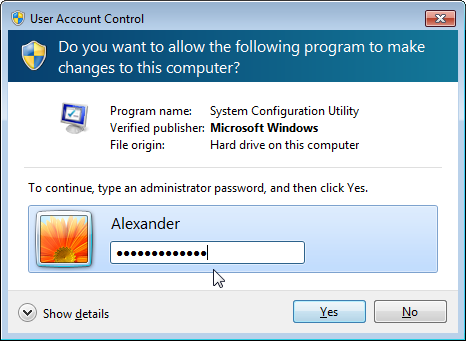 |
| Figure 1 - Windows Vista User Account Control Prompt |
In The Cuckoo's Egg, Clifford Stoll recounts the tale of how he discovered and tracked a computer hacker through his system back in the early days of interconnected computers. Many of the security holes the hacker used were there because System Administrators had not secured their systems correctly. They left default accounts active, or used software with bugs that created security loopholes. Often the reason for the security blunders was to make access for legitimate users more convenient. Unfortunately this also had the side effect of unlocking the door for intruders as well.
So what can be done? Where is the balance between usability and security to be found? A Google search for security vs usability gives 1,730,000 results, none of them giving a real definitive answer. People are thinking about it though, so at least we're moving in the right direction.
Tuesday, October 8, 2013
More than a Bird's Eye View
There are now autonomous drone aircraft that can stay aloft for nearly five years at a go. That's 43,680 flight hours at a time. Amazing. By the time the aircraft is ready to make it's first landing it will probably have been obsolete for at least three years already. And if we've got drones that can keep an eye on someone for five years straight we know that some government agency has plans for it. Aside from the creepier uses however, I can imagine quite a few different scenarios where a drone flying continuously at 65,000 feet would be quite useful. Search and rescue operations, live map data, mobile satellite links, GPS-supplementing systems for mountainous regions--and more. I want to see one of these in action. Or at least a video feed being streamed from 65,000 feet up. And I think soon we'll be seeing drone aircraft that can stay aloft indefinitely--we'll just set them adrift on the atmosphere, like leaves floating on the surface of a pond, and they'll send back everything they can see below the surface.
Sunday, October 6, 2013
Can you keep up with #ldsconf?
I followed tweets of #ldsconf on Twitter during the last session of General Conference to see if it would enhance my conference experience. It may have been the method I was using, but I felt extremely distracted from the actual talks being given while trying to read what people were tweeting about them. The site I was using to follow the tweets allowed me to control the feed speed, but I found that if I slowed it down too much, the queue of tweets waiting to be displayed would grow quickly, and soon there would be thousands of tweets waiting to be read. Then, if I clicked the button to display everything and bring me up to current I wouldn't have the time to go and read the tweets that I just displayed. I finally put the speed up as fast as it would go, and just decided to skim the tweets. This didn't actually empty the queue, it just kept it from filling up too fast. Using twitter as a tool to enhance my conference viewing experience was a failure I think. It was amusing, however, to see people tweeting about the fly that kept bothering the speakers. Where I do think it would be useful is in analyzing what resonated with people after the fact, to see what people were excited about. That kind of analysis could be useful to the general authorities who gave the talks in gauging whether their message got across in the way they intended, or not.
Thursday, October 3, 2013
Family History--now with achievements!
Some of my earliest memories of visiting my paternal Grandparent's involve watching them boot up their MS-DOS PC, load up PAF (Personal Ancestral File), and do "family history." I would stare at the bright blue screen, fascinated that contained on a number of tiny 3.5" disks were thousands of names of my ancestors and relatives, stretching back to who knew how far. Some of them even had stories attached to their names, which I enjoyed reading. It was amazing to me that we had such easy access to all of that information. Genealogy, or family history research is so much easier today, than it was when I was a child, and that was leaps ahead of when my parents were kids. But it seems that people my age (including myself) have little interest in doing the work to find out about their heritage, or believe that their parents and grandparents have already done it all. It's so simple, though. Just now I logged in to Family Search and while I was able to trace my ancestors back 11 generations to find Peder Jensen (who died sometime in the 1600s) in seconds, there was a lot of missing information, or incomplete branches. We need a motivator for my generation to pick up the torch. I wonder if adding achievements for filling in holes in your family tree would help boost interest? There could be achievements for how bushy you've made your tree, and for reaching certain milestones for how many generations back you've traced personally. You could post your achievements to Facebook, or Google+ to show your friends how much further you've traced your tree. Adding game elements like that could work. Somebody get on that.
Note: While PAF is no longer available for download, you can use Family Search online, and other software products such as AncestralQuest, Legacy Family Tree, or RootsMagic have picked up the PAF torch.
Note: While PAF is no longer available for download, you can use Family Search online, and other software products such as AncestralQuest, Legacy Family Tree, or RootsMagic have picked up the PAF torch.
Tuesday, October 1, 2013
I'll have the 큰 페퍼로니 피자
Imagine being able to walk into a restaurant anywhere in the world, pick up the menu and place your order, all while not being able to understand the language, but still comprehending what you will be eating. NTT Docomo, a Japanese technology company, is working on a wearable computer similar to Google Glass that will let you do this, and more. It's reminiscent of the babelfish of Hitchhiker's Guide to the Galaxy fame--though not quite up to that standard, yet. Devices that can translate text on the fly will be incredibly useful. WHO representatives, students studying abroad, international businessmen, historians, electronic device repairmen--anyone who often sees text written in a foreign language would find the ability of immediate benefit. This is world-expanding. I want one. I want to order novels and books in languages I would never have the time to learn, and be able to read them without issue. I want to be able to travel to China or Russia, and be able to get news directly from the local newspapers. There is such a large and immediate user base for something like this that I'm surprised it hasn't already been perfected--and the translation feature is only one of its uses. I'm sure Google is working on a translation app for Google Glass as well. Now we just need to get them to add on-the-fly audio translation.
Tuesday, September 24, 2013
You may copy this post
The MPAA and RIAA have helped create (in conjunction with the Center For Copyright Information and the Internet Keep Safe Coalition) a curriculum on copyright infringement for use in public schools. It's aimed at elementary school kids and seems heavily biased towards content owners. Currently part of a pilot program in California, there are hopes for it to be applied nationally. Both Wired and Torrentfreak have articles reviewing the material and it sounds like the program will only teach one side of copyright--that we always need permission to use someone else's creation--even though the Fair Use Doctrine explicitly states the opposite. Copyright law in this country is already absurd: a term of life of the author +70 years, and for corporate works it's 120 years after creation or 95 years after publication. That's an insane amount of time for a creative work to be kept from the public domain. Almost five times what copyright terms were when the US was getting started (assuming the author dies around 80). As an artist myself, I want my works to be protected--but I think we need to come up with something more reasonable than what we've currently got. I propose that the copyright term for a creative work last for a period of 25-50 years, or until the author's death--whichever is longer. This lets the author receive benefit from his work during his lifetime (or lets his descendants benefit for a short period after his death) while ensuring the work will still enter the public domain in a reasonable time frame. Of course, when we start living to 200 years we'll need to re-examine the terms. And in the meantime, let's teach our kids what the laws actually state about the use of other's creative works.
(This post was inspired by these articles regarding the new copyright infringement based curriculum: http://www.wired.com/threatlevel/2013/09/mpaa-school-propaganda/; http://torrentfreak.com/mpaa-and-riaa-to-teach-copyright-at-kindergartens-130918/; and by the letter C, and the number 2013.)

(This post was inspired by these articles regarding the new copyright infringement based curriculum: http://www.wired.com/threatlevel/2013/09/mpaa-school-propaganda/; http://torrentfreak.com/mpaa-and-riaa-to-teach-copyright-at-kindergartens-130918/; and by the letter C, and the number 2013.)
Thursday, September 12, 2013
Technology for Everyone!
Tens of thousands of people line up each year to attend E3, MacWorld, CES and other such events to be the first to experience everything new. Being an "early adopter" can even become a full-time job now, with youtube offering monetization options. But is there a downside to this fast-paced rate of change we are experiencing? It's not something that I've really stopped to think about much myself until now. It's like we're becoming addicted to "new". New phones, new laptops, new tablets, new cars. Getting your hands on a new toy is exciting. And there's that little rush of adrenalin when I first unbox a new gadget. Then there is all the electronic waste we're building up from our constant need for new items. I've seen landfills composed entirely of discarded computers and monitors. Just sitting out there. No recycling, no reuse. It's incredible to me. If we're going to continue to drive the ever-increasing rate of technological advancement, I think we also need to look at the other end, and take care of what's being discarded.
Subscribe to:
Posts (Atom)